
☁️💻 Business Overview
🎯Key Metrics
Total: 8/17
+2 ✅✅ Projected Operating Margin: 32.95%
+1 ✅ Projected 5-Year Revenue CAGR: 12.76%
+0 ⚠️ Last 5-Year ROIC: 8.80%
-2 ❌❌ Estimated Cost of Capital: 9.01% (greater than ROIC)
+1 ✅ Last 5-Year Shares Outstanding CAGR: -0.21%
+2 ✅✅ Projected 5-Year EPS CAGR: 22.90%
+1 ✅ Projected 5-Year Dividend CAGR: 11.02%
+1 ✅ Moody’s Rating: A1
+2 ✅✅ Morningstar Moat: Wide
+0 ⚠️ Morningstar Uncertainty: Medium
SAP is a good company with a wide moat, very high margins and solid growth overall. However the fact that the ROIC 5 Year Average is less than its estimated cost of capital should be something to watch out for because it could mean that the company is destroying value and given its revenue growth, at an accelerated pace.
📈Business Valuation
To calculate the intrinsic value of the company I’ll use multiple methods:
Discounted Cash Flows (DCF) – Intrinsic value is estimated by projecting SAP’s free cash flows over the next 10 years and discounting them to present value;
EPS Growth – the fair value is estimated by projected the Earnings Per Share CAGR for the next 5 Years and then, given its current and historic values of PE, come up with a PE for the 5th Year. This will give us its price 5 Years from now using the formula: Price = EPS x PE that we then discount using the estimated cost of capital;
Historical P/E – we assume mean reversion to the historical PE values;
Historical EV/EBITDA – we assume mean reversion to the historical EV/EBITDA values;
Historical P/S – we assume mean reversion to the historical P/S values;
Historical P/CF – we assume mean reversion to the historical P/CF values.
I’ll give more weight to the DCF and EPS methods, and only then the historical ones. Giving the changing landscape of the technology field, and the world in general, is very difficult to believe that in 100% of the cases mean reversion to historical values is guaranteed.
Cost of Capital
I’ve used both the latest and annual financial statements of the company, the 10-Year Germany bonds as the risk free rate and the company Moody’s rating and revenue geographic exposure to come up with its cost of capital, cost of debt and cost of equity.
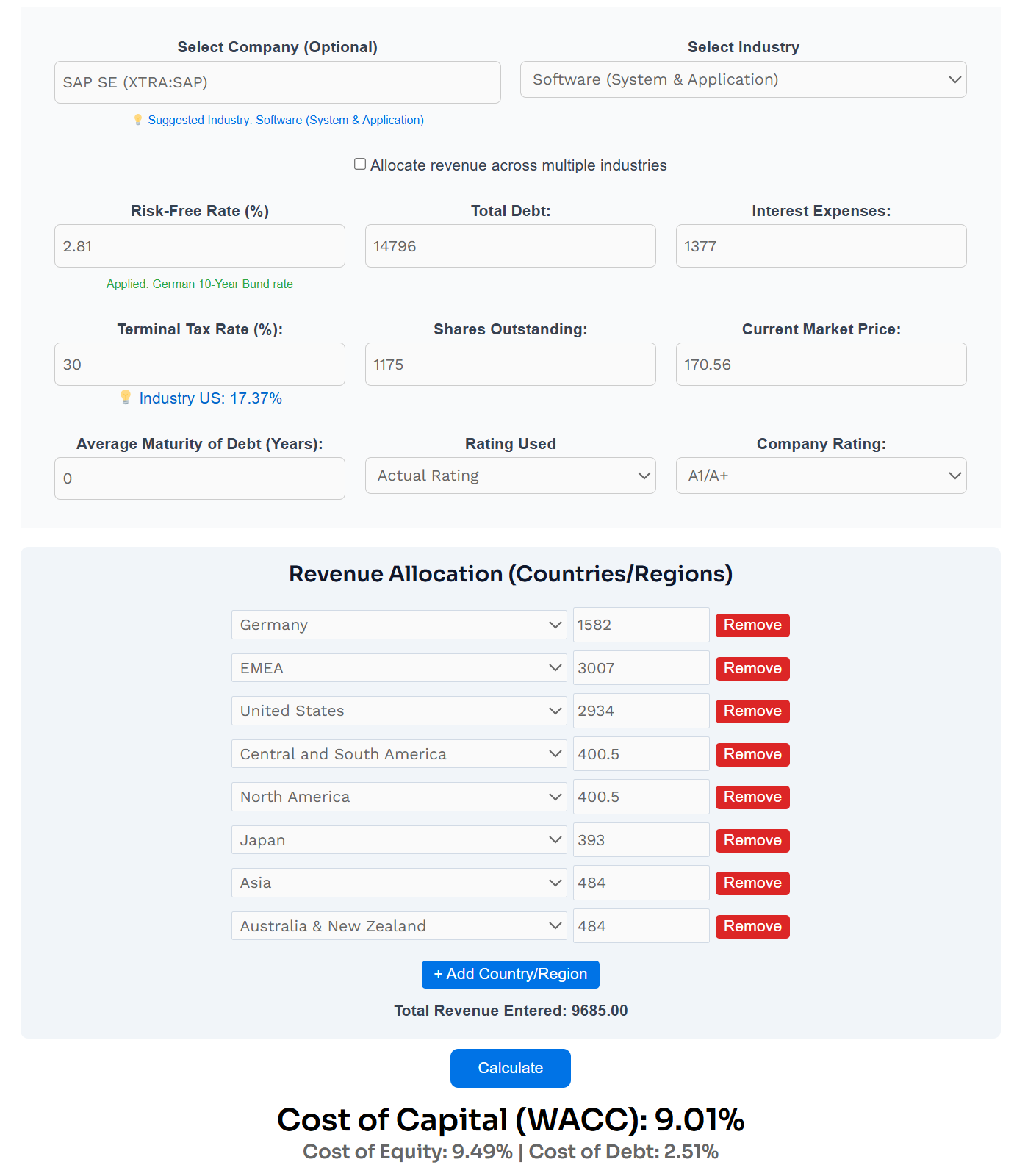
Cost of Capital: 9.01%.
This value will be used later as a discount rate in the valuation methods.
Please feel free to come up with your own values by using the tool I’ve used: Cost of Capital – The Fair Value Journal. It is and will ever be completely free 🙂
Discounted Cash Flows (Weight: 30%)
I’ve used the latest and annual financial statements of the company, the analyst estimates for both revenue and margins and the cost of capital calculated previously.
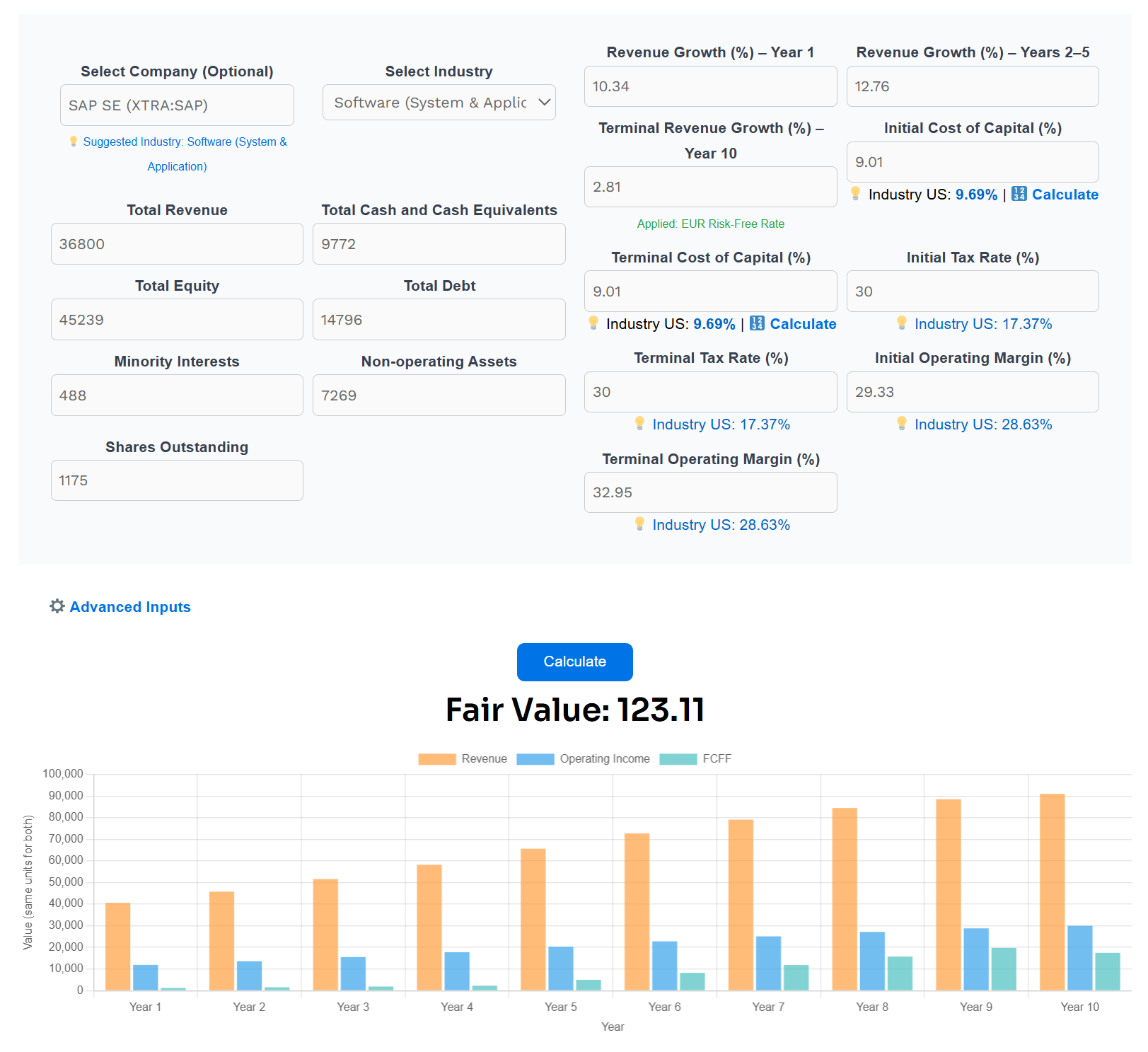
This gives us a estimated fair value of 123.11 euros for SAP.
We can also do some Monte Carlo simulations to execute multiple DCF valuations. Each simulation will randomize the inputs between some pre-defined values. For this I also used analysts estimates.

As you can see from the above SAP seems to be overvalued, using DCF, because even on the higher end of the simulations its DCF estimated fair value is still very low compared to the company’s current price.
Please be free, as before, to fill in your own values. Make the valuation your own and do yourself a DCF valuation for SAP using your own assumptions: DCF – The Fair Value Journal
EPS Growth (Weight: 20%)
For this simple valuation method, I’ve used the current EPS and the analysts estimates of EPS growth. I also assumed a 25 PE for SAP.
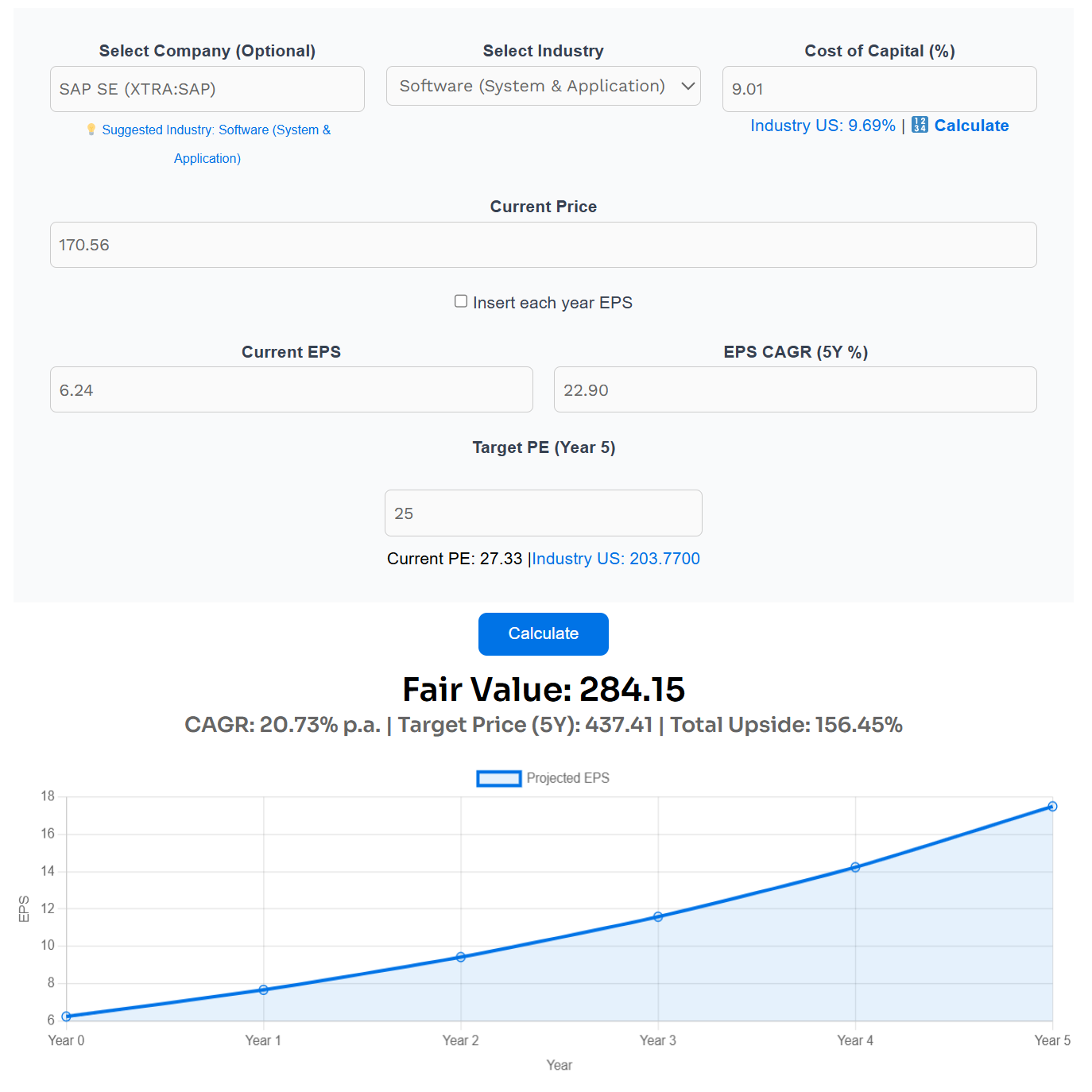
Then again, used the Monte Carlo simulations to check how the estimated fair value changed as my assumptions were modified.
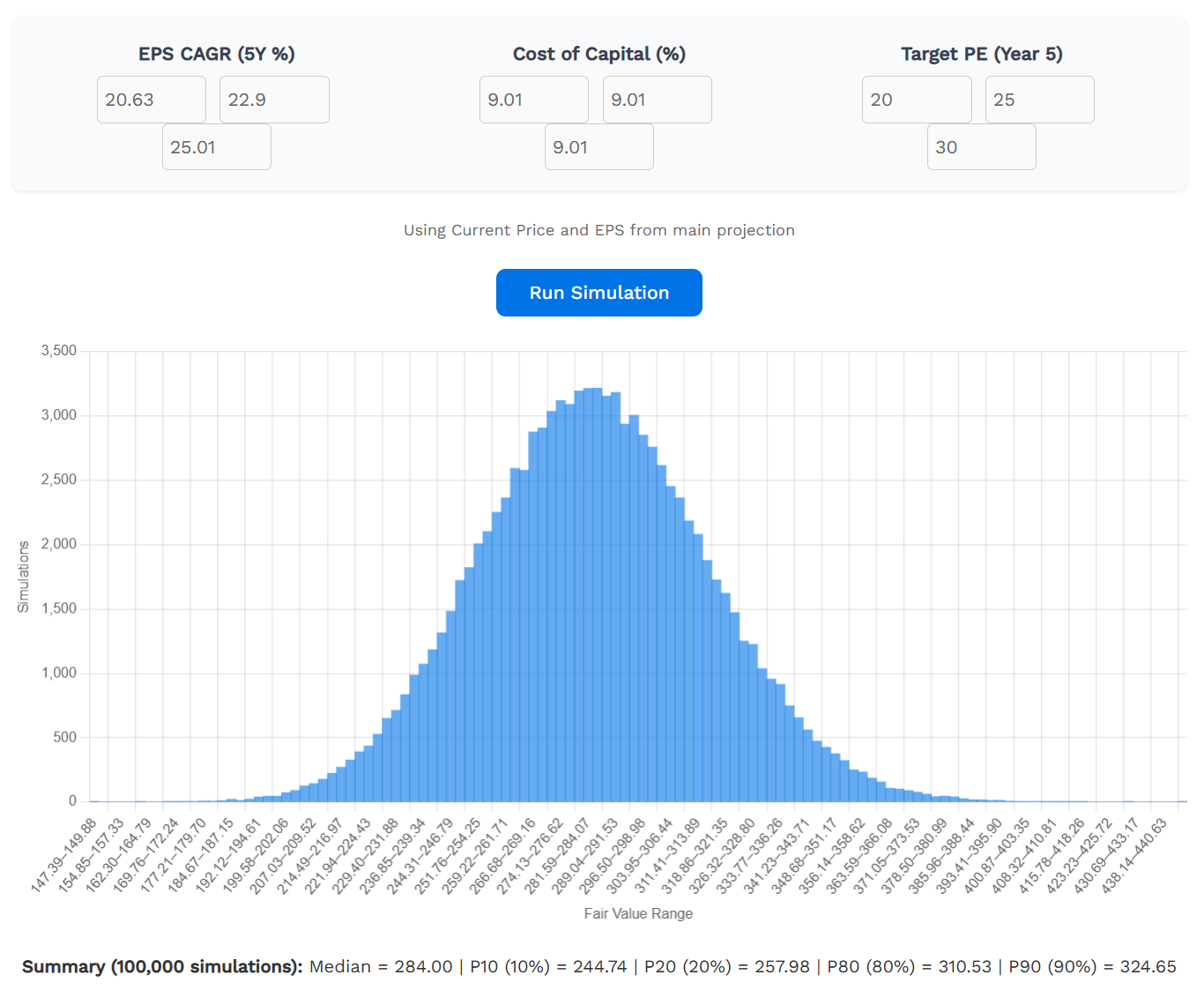
Using this valuation method, SAP that is currently priced at 170.56 euros, seems to be undervalued being currently valued below the P10 that is 244.74 euros. What this means is that given that it’s below P10, exists 90% of chance for the real value of SAP to be above 244.74 euros.
However, please note that the previous DCF gave a much lower value, so let’s continue.
As before, feel free to try this yourself: EPS Growth – The Fair Value Journal
Historical P/E (Weight: 15%)
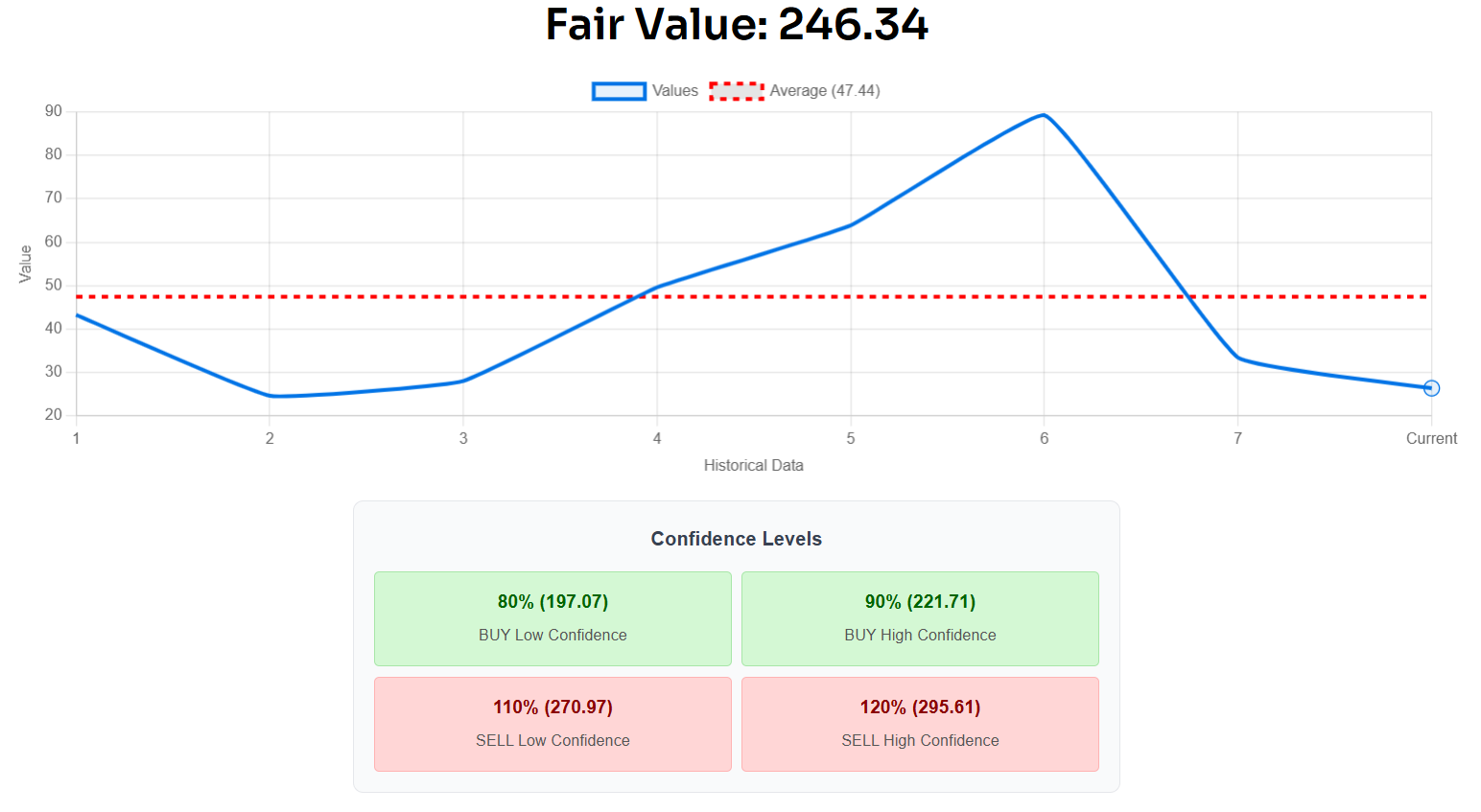
The current P/E ratio is below its 7-8 Year average, this could mean the stock is undervalued. Using its historical average and comparing it to today’s price we reach a fair value of 246.34 euros.
For every type of historical and relative valuation you can use the same free tool: Historical / Relative Valuation – The Fair Value Journal .
Historical EV/EBITDA (Weight: 15%)
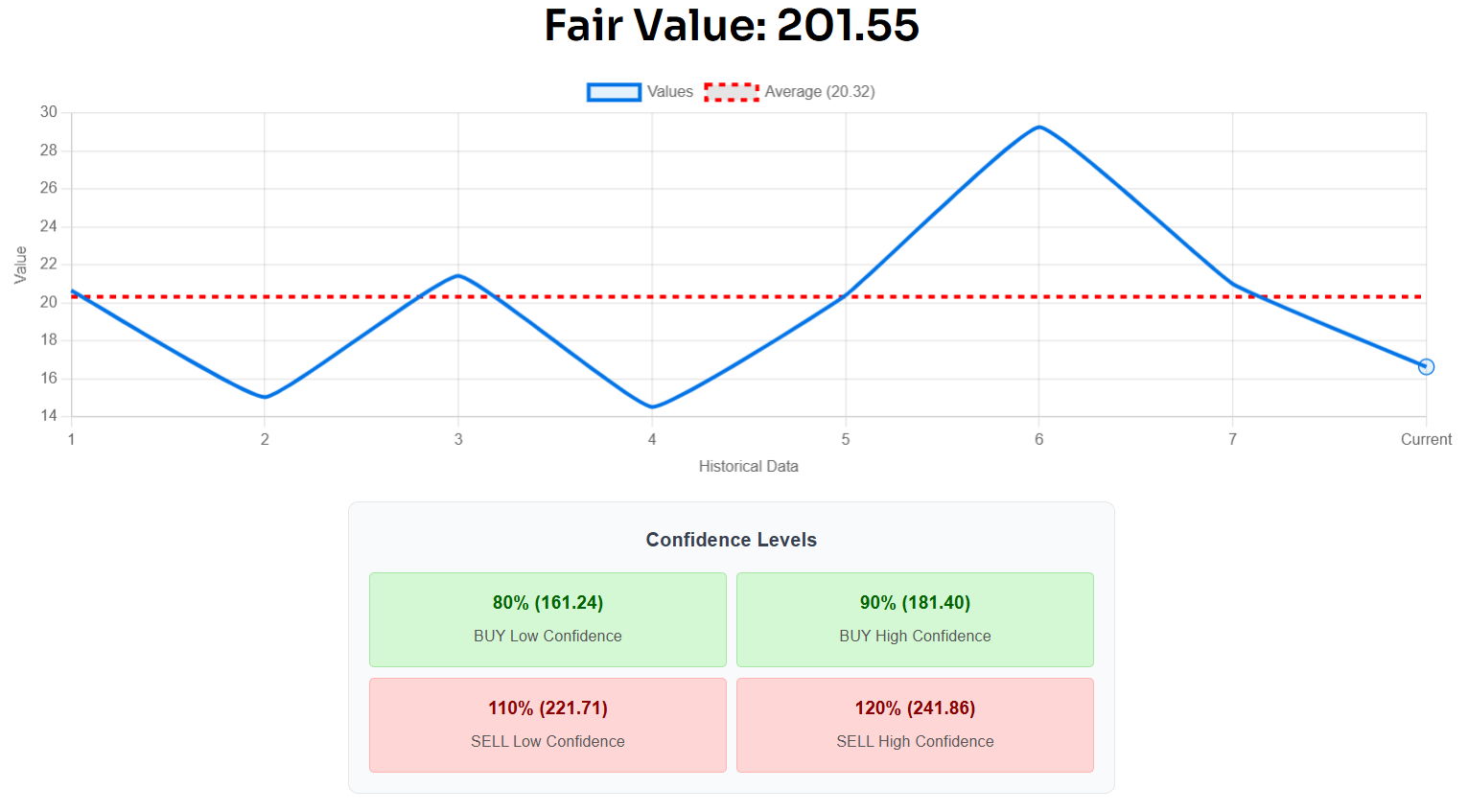
Its current EV/EBITDA is below its average over the last 7 Years. This could mean the stock is undervalued. Comparing it to the today’s price we reach a fair value of 201.55 euros.
Historical P/S (Weight: 10%)

The current P/S ratio is a little below or at its historical average and this means that the company is undervalued or at maximum fairly valued given this comparison. We reach the fair value of 180.95 euros.
Historical P/CF (Weight: 10%)
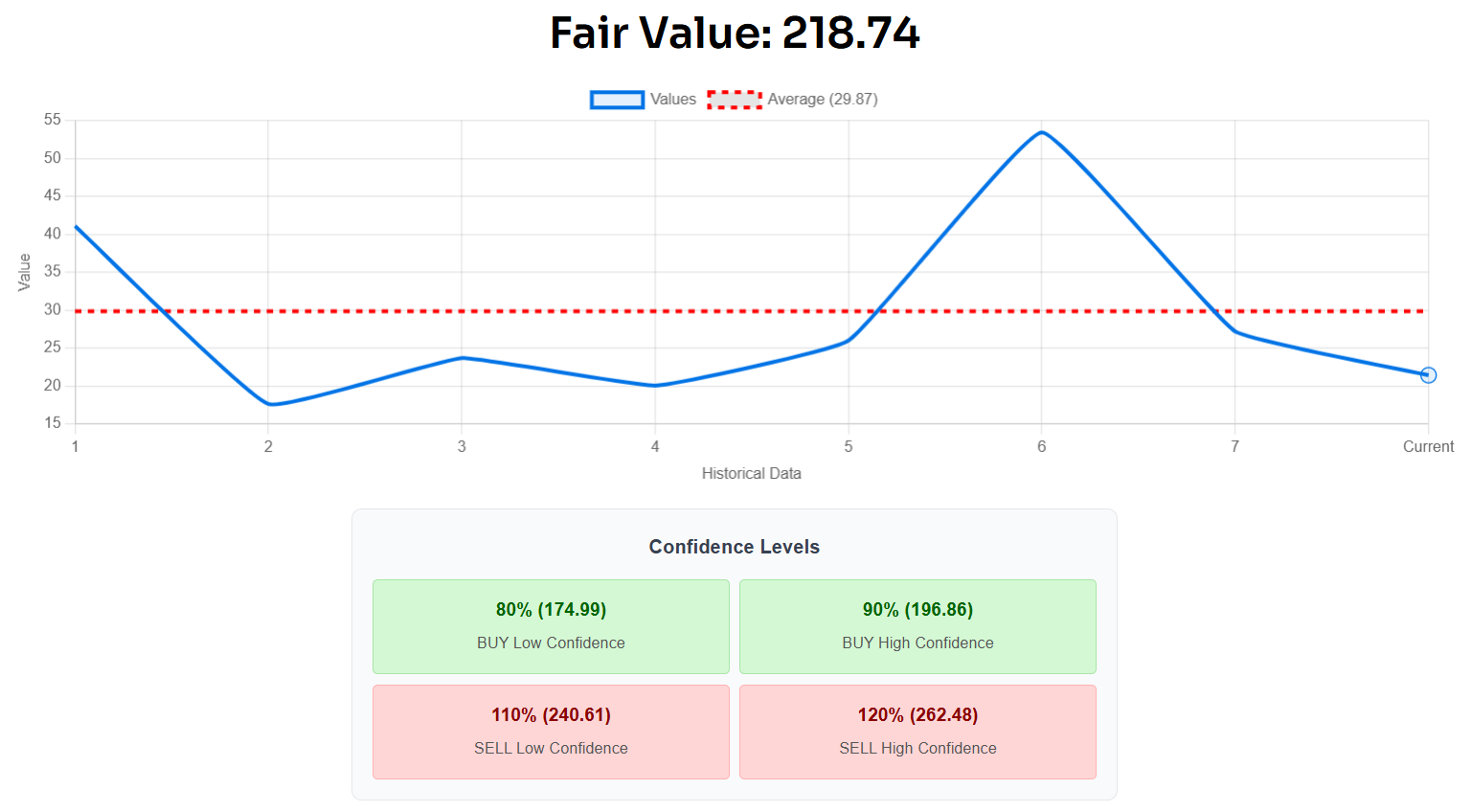
The current P/CF value is below its historical average. This could mean the stock is undervalued and we reach a fair value of 218.74 euros, given its historical values and assuming mean reversion.
💰 Fair Value Estimate
Now that we did all the heavy work, let’s take the above and come up with the company weighted average fair value.
I basically take each valuation method used and given my confidence on the company apply a 20% or 10% discount (when to buy) and addition (when to sell) or use the monte carlo P10, P20, P80 and P90 values:
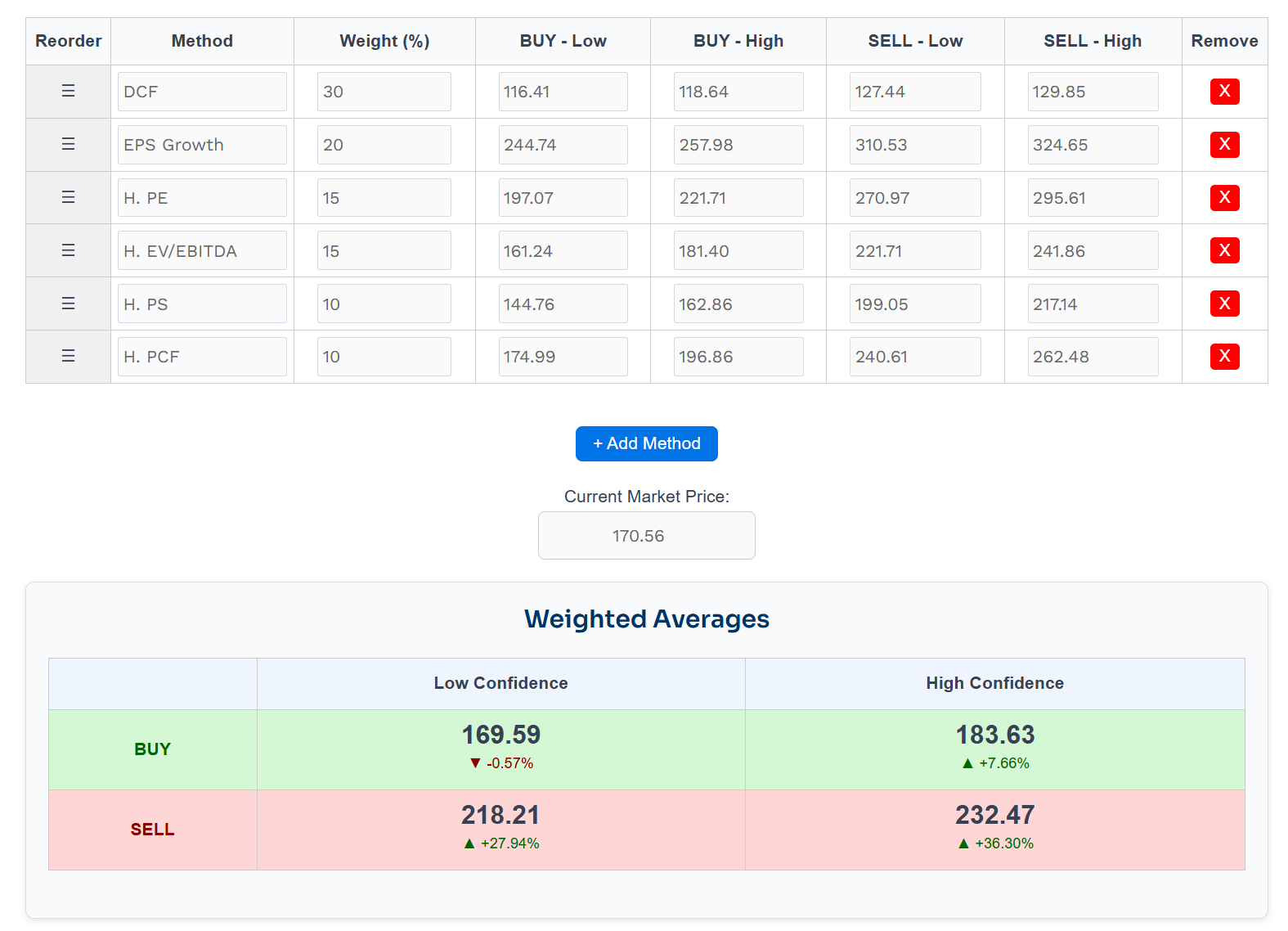
Feel free to choose your own values, but for me I’ll take a fair value of 183.63 euros for SAP given my confidence that its wide moat, fueled by the high migration and switching costs that companies have to replace it, deserves a High Confidence value.
Please remember that the fair value estimate is just a number and, probably, a very wrong number. However, overall, SAP seems to be undervalued or at maximum fairly valued at the moment.