
🤳📱 Business Overview
🎯Key Metrics
Total: 11.5/17
+2 ✅✅ Projected Operating Margin: 37.28%
+1 ✅ Projected 5-Year Revenue CAGR: 12.10%
+2 ✅✅ Last 5-Year ROIC: 23.00%
+1 ✅ Estimated Cost of Capital: 10.49% (lower than ROIC)
+1 ✅ Last 5-Year Shares Outstanding CAGR: -2.64%
+1 ✅ Projected 5-Year EPS CAGR: 11.62%
+1 ✅ Projected 5-Year Dividend CAGR: 11.97%
+1.5 ✅ Estimated Debt Rating: Aa3
+2 ✅✅ Morningstar Moat: Wide
-1 ❌ Morningstar Uncertainty: High
Meta has a great business, having good ratings on all the metrics presented here. The only thing that we can really pinpoint is some uncertainty regarding its business, namely the “fatigue” on social network by young ones and the high probability of its use being highly regulated in the future.
However, Meta has a really good probability of venturing successfully through the next waves of technological revolution there is, diversifying more its business.
📈Business Valuation
To calculate the intrinsic value of the company I’ll use multiple methods:
Discounted Cash Flows (DCF) – Intrinsic value is estimated by projecting its free cash flows over the next 10 years and discounting them to present value using the estimated cost of capital;
EPS Growth – the fair value is estimated by projected the Earnings Per Share CAGR for the next 5 Years and then, given its current and historic values of PE, come up with a PE for the 5th Year. This will give us its price 5 Years from now using the formula: Price = EPS x PE that we then discount using the estimated cost of capital;
Historical P/E – we assume mean reversion to the historical P/E values;
Historical EV/EBITDA – we assume mean reversion to the historical EV/EBITDA values;
Historical P/S – we assume mean reversion to the historical P/S values;
Historical P/CF – we assume mean reversion to the historical P/CF values;
Historical P/B – we assume mean reversion to the historical P/B values.
Cost of Capital
I’ve used the latest annual financial statement of the company, the 10-Year US bonds as the risk free rate and revenue geographic exposure to come up with its cost of capital, cost of debt and cost of equity. Also, given the fact that Moody’s provided a rating for the company I used it as the debt rating.
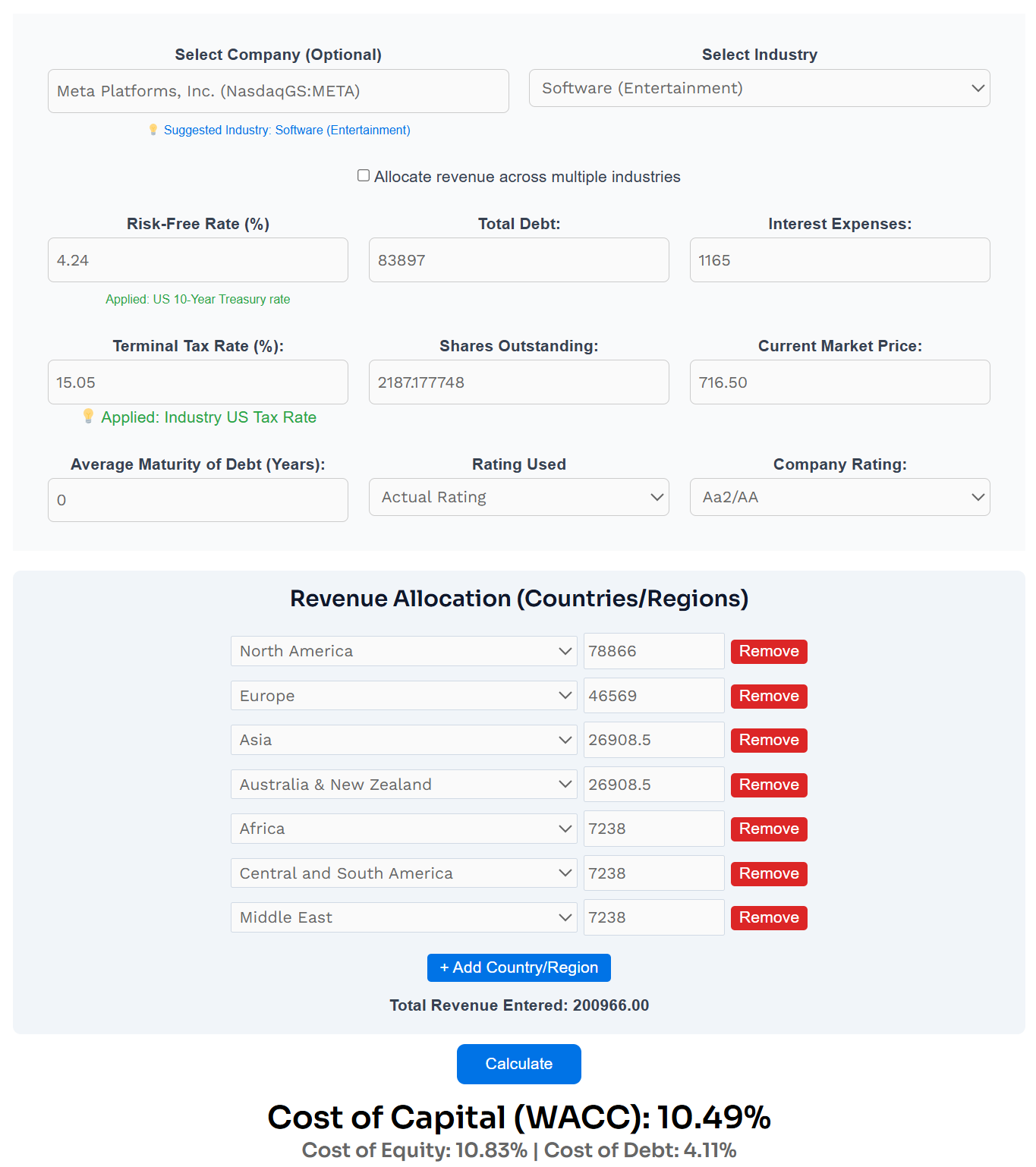
Cost of Capital: 10.49%.
This value will be used later as a discount rate in the valuation methods.
Please feel free to come up with your own values by using the tool I’ve used: Cost of Capital – The Fair Value Journal. It is and will ever be completely free 🙂
Discounted Cash Flows (Weight: 35%)
I’ve used the latest annual financial statement of the company, the analyst estimates for both revenue and margins and the cost of capital calculated previously.
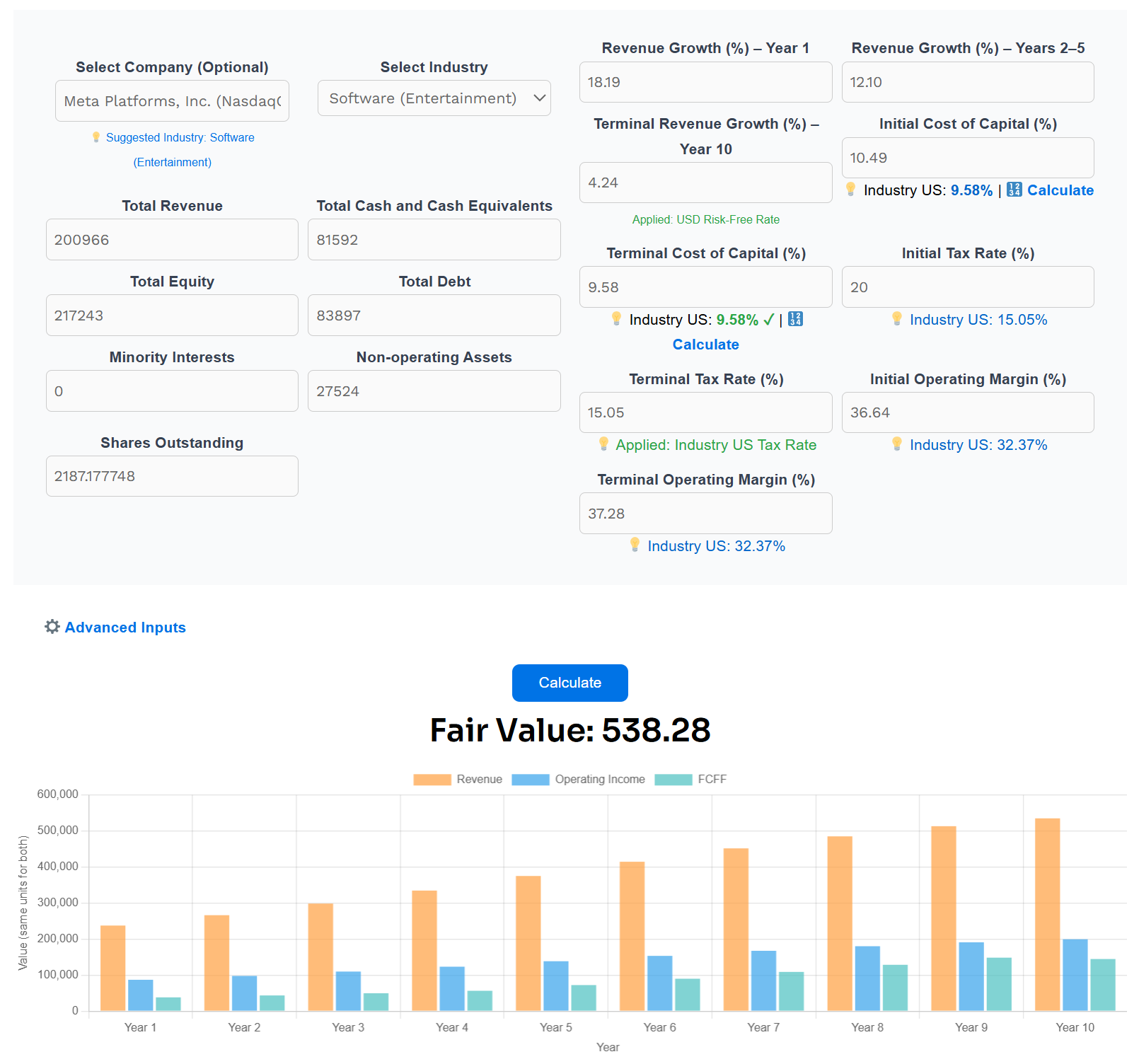
Some notes on the inputs above:
Terminal Revenue Growth – I’m using the risk-free rate (10-Yr bonds of the US), because long term the company should not grow more than the rate of the economy. I’m using the risk-free rate as a proxy to it, so the terminal growth becomes it;
Terminal Cost of Capital – I’m assuming its Cost of Capital begins at its current estimated value and then gradually converges to the industry average;
Initial and Terminal Tax Rate – I’m assuming it starts at its recent averages and then gradually converges to the industry average.
All the other inputs were taken from the financial statement or from analyst projections.
The DCF gives us an estimated fair value of 538.28 dollars for Meta.
Something that we can also do now is to play around with Monte Carlo simulations. What this will allow us to do is to simulate multiple DCF valuations with pre-defined ranges for each of the inputs. Each simulation will randomize the inputs between these pre-defined values. For this I also used analysts estimates.

As you can see from the above Meta seems to be overvalued given that its current price of 716.50 dollars is well above P90. From these simulations we can extrapolate that there’s more than ~90% probability of Meta being overvalued.
Please be free, as before, to fill in your own values. Make the valuation your own and do yourself a DCF valuation using your own assumptions: DCF – The Fair Value Journal
EPS Growth (Weight: 30%)
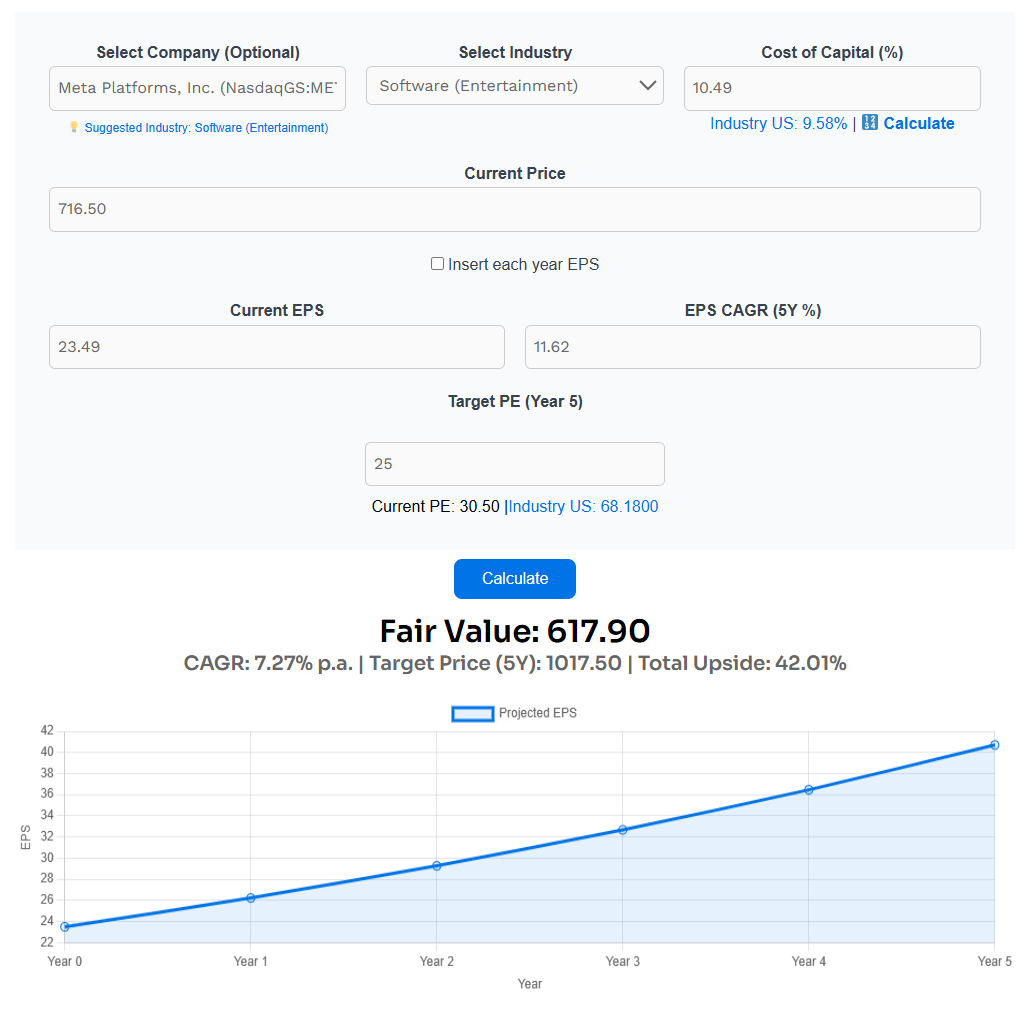
For this valuation method, I’ve used the current EPS and the analysts estimates of EPS growth. I also assumed a 25 PE for the company.
Then again used the Monte Carlo simulations to check what happens when the input values change within a specified range:
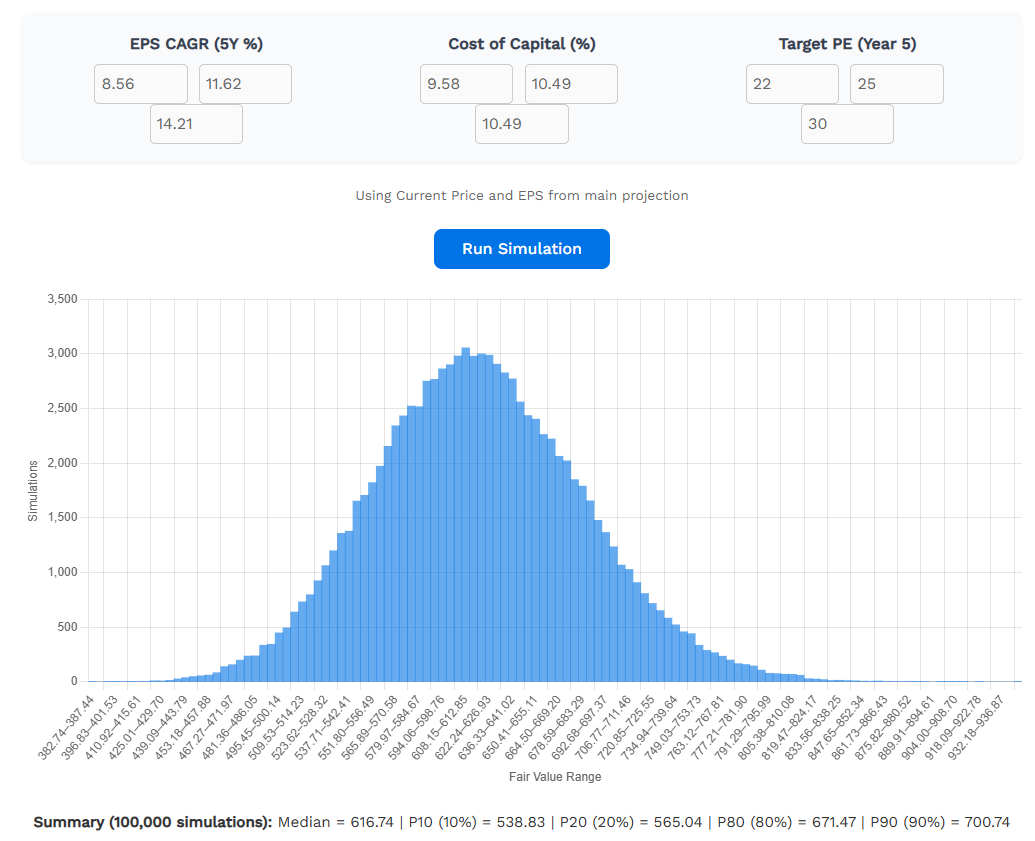
Using this valuation method, Meta that is currently priced at 716.50 dollars seems to be overvalued being currently valued a little above P90. From this we can extrapolate that there’s around 90% probability that the stock is overvalued.
As before, feel free to try this yourself: EPS Growth – The Fair Value Journal
Historical P/E (Weight: 15%)
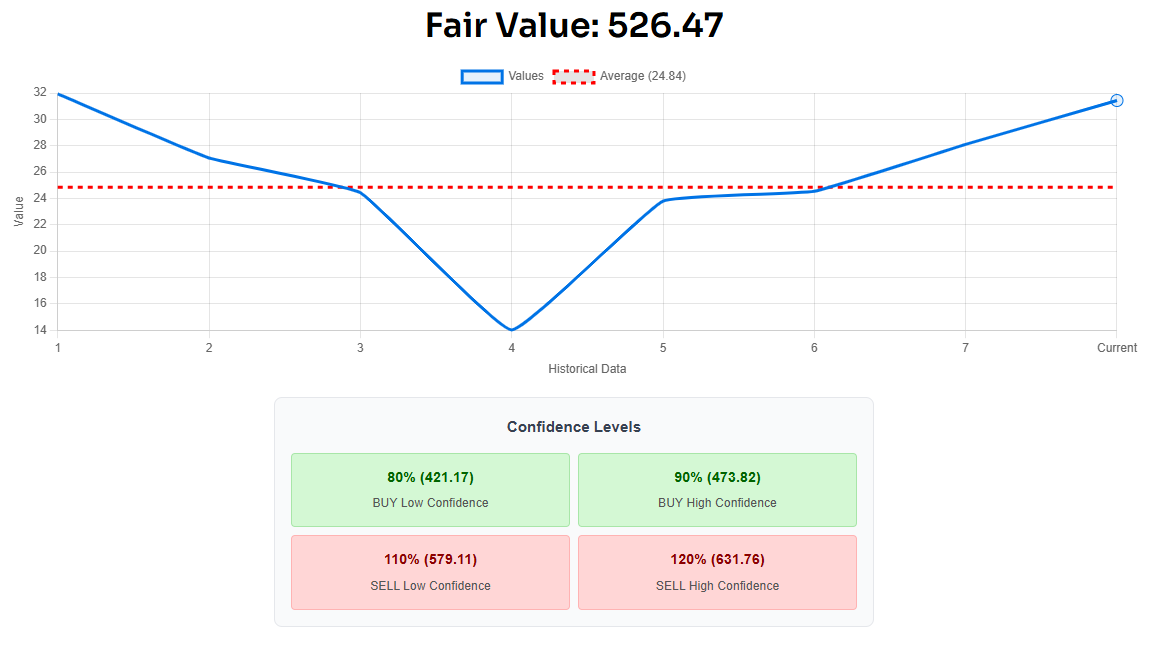
The current P/E (Price / Earnings) ratio is above its 7-8 Year average. This means that the company is overvalued by this metric. Assuming a mean reversion to its historical average of 24.84 we can assume a fair value of 526.47 dollars.
For every type of historical and relative valuation you can use the same free tool: Historical / Relative Valuation – The Fair Value Journal
Historical EV/EBITDA (Weight: 10%)
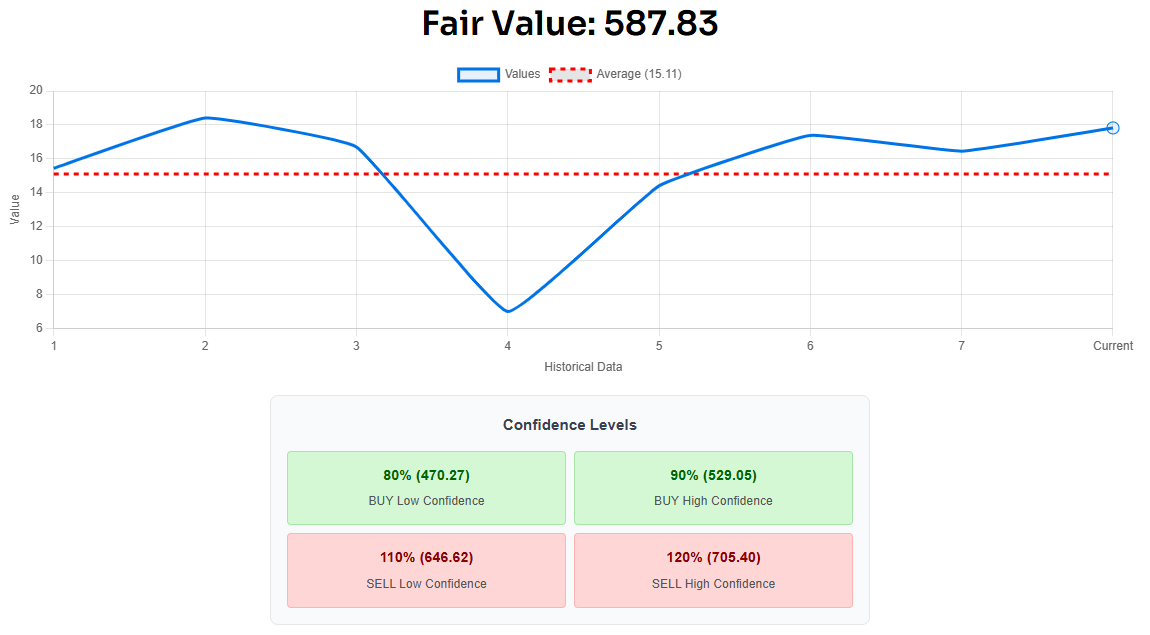
The current EV/EBITDA (Enterprise Value / Earnings Before Interests, Taxes, Depreciation and Amortization) ratio is above its 7-8 Year average. This means that the company is overvalued by this metric. Assuming a mean reversion to its historical average of 15.11 we can assume a fair value of 587.83 dollars.
Historical P/S (Weight: 5%)
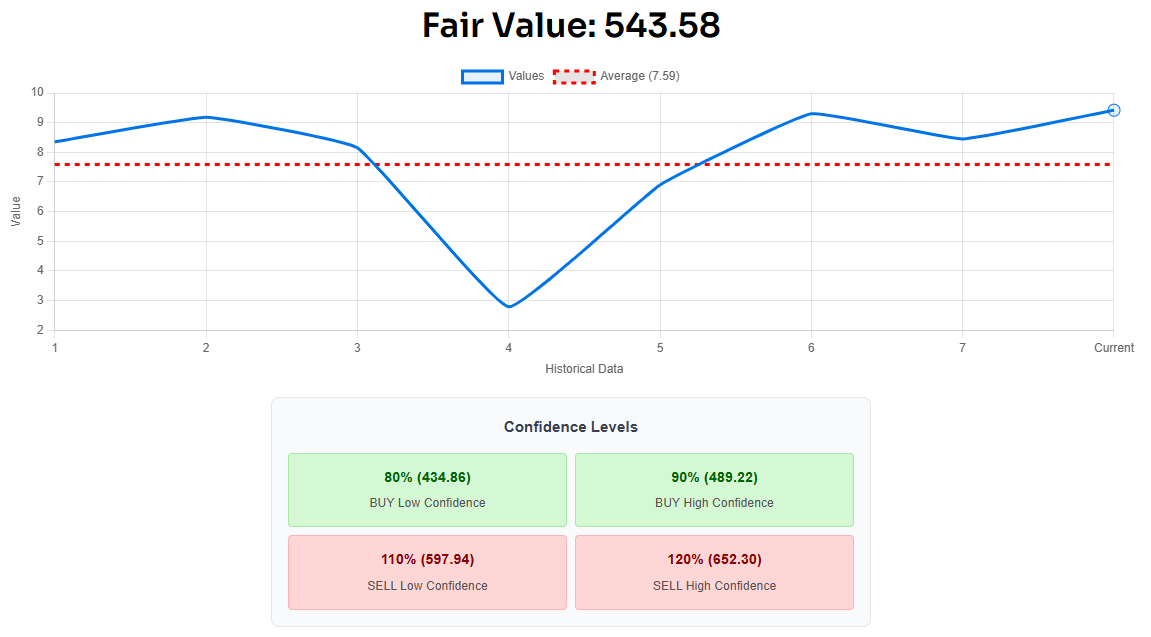
The current P/S (Price / Sales) ratio is above its 7-8 Year average. This means that the company is overvalued by this metric. Assuming a mean reversion to its historical average of 7.59 we can assume a fair value of 543.58 dollars.
Historical P/CF (Weight: 3%)
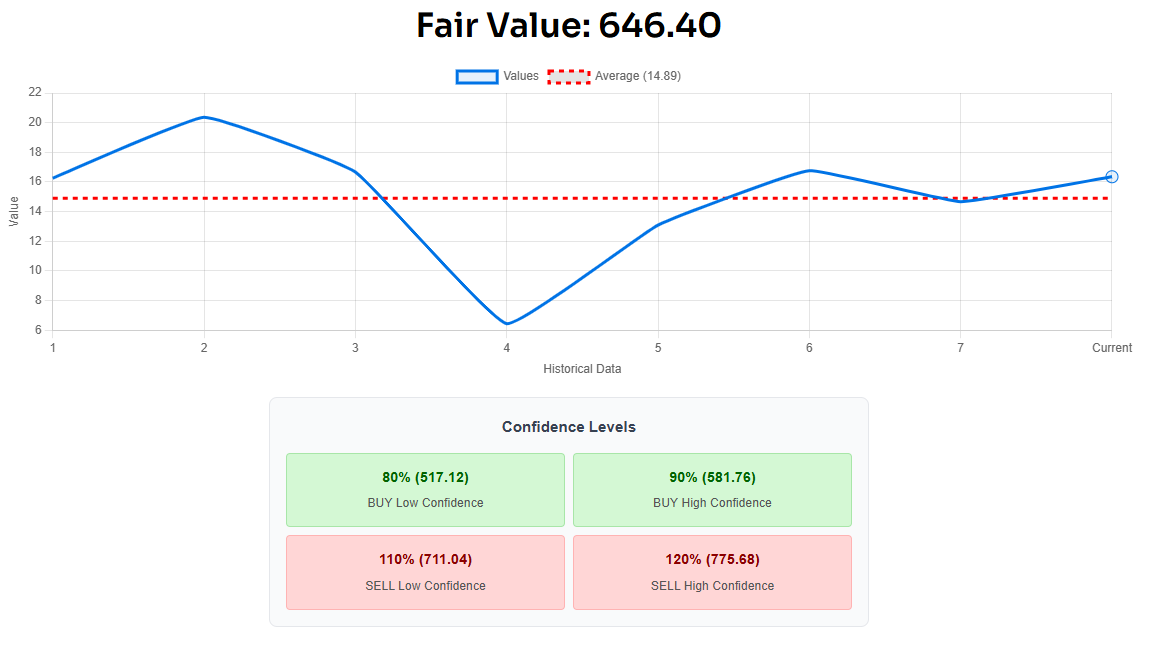
The current P/CF (Price / Free Cash Flow) ratio is above its 7-8 Year average. This means that the company is overvalued by this metric or at least fairly valued. Assuming a mean reversion to its historical average of 14.89 we can assume a fair value of 646.40 dollars.
Historical P/B (Weight: 2%)
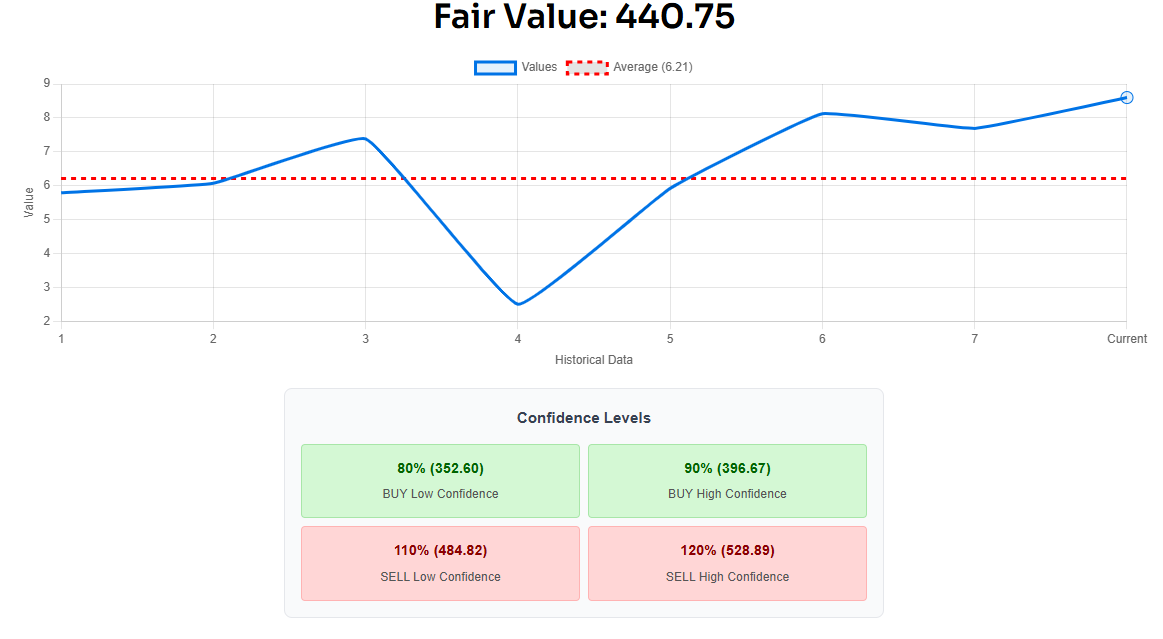
The current P/B (Price / Book) ratio is above its 7-8 Year average. This means that the company is overvalued by this metric. Assuming a mean reversion to its historical average of 6.21 we can assume a fair value of 440.75 dollars.
✍️Summary
Now that we did all the heavy work, let’s take the above and come up with the company weighted average fair value.
I basically take each valuation method used and given my confidence on the company apply a 20% or 10% discount (when to buy) and addition (when to sell) or use the Monte Carlo P10, P20, P80 and P90 values:

Feel free to choose your own values, but for me I will pick a fair value of 510.28 dollars given the overall moat of its social network business but also the overall opportunities this company may find in the next couple of years to expand and diversify its business.
Overall it seems Meta is overvalued at the current prices.
Fair Value: 510.28 dollars