
🍕Business Overview
🎯Key Metrics
Total: 8/17
-
+1 ✅ Projected Operating Margin: 19.87%
-
+0 ⚠️ Projected 5-Year Revenue CAGR: 5.14%
-
+2 ✅✅ Last 5-Year ROIC: 55.60%
-
+1 ✅ Estimated Cost of Capital: 7.78% (less than ROIC)
-
+1 ✅ Last 5-Year Shares Outstanding CAGR: -3.09%
-
-1 ❌ Projected 5-Year EPS CAGR: 9.50% (given the easiness of “manipulation” of EPS growth below 10% represents a slight negative)
-
+1 ✅ Projected 5-Year Dividend CAGR: 12.72%
-
+1 ✅ Estimated Debt Rating: A3
-
+2 ✅✅ Morningstar Moat: Wide
-
+0 ⚠️ Morningstar Uncertainty: Medium
Domino’s Pizza is a great brand, enjoying a wide moat that results in an operating margin of around ~20%. Given the maturity of the business, its revenue growth is below 10% but still modestly above the economy growth rate. Its franchise business model and disciplined capital allocation decisions also result in a stellar ROIC around 7 times its cost of capital. The reduction in shares outstanding over the last five years has also increased each shareholder’s ownership stake (“pizza slice”) in the company.
📈Business Valuation
To calculate the intrinsic value of the company I’ll use multiple methods:
- Discounted Cash Flows (DCF) – Intrinsic value is estimated by projecting its free cash flows over the next 10 years and discounting them to present value using the estimated cost of capital;
- DDM (Variable Growth) – Intrinsic value is estimated by projecting how much the company will pay in dividends over the next couple of years and then “forever”, discounting everything to the present value using the estimated cost of equity;
- EPS Growth – the fair value is estimated by projected the Earnings Per Share CAGR for the next 5 Years and then, given its current and historic values of PE, come up with a PE for the 5th Year. This will give us its price 5 Years from now using the formula: Price = EPS x PE that we then discount using the estimated cost of capital;
- Historical Dividend Yield – we assume mean reversion to the historical dividend yield values;
- Historical P/E – we assume mean reversion to the historical P/E values;
- Historical P/CF – we assume mean reversion to the historical P/CF values;
- Historical P/S – we assume mean reversion to the historical P/S values;
- Historical EV/EBITDA – we assume mean reversion to the historical EV/EBITDA values.
I’ll put more weight on the DCF method and only then the others. Given the maturity of the company and also its consistent dividend payments these type of valuation methods will have more weight that I normally attribute to them.
Cost of Capital
I’ve used the latest annual financial statements of the company, the 10-Year US bonds as the risk free rate and revenue geographic exposure to come up with its cost of capital, cost of debt and cost of equity. Also, given the fact that Moody’s does not provide a rating for this company we’ll estimate it by passing its Operating Income (Earnings Before Interest and Taxes – EBIT).
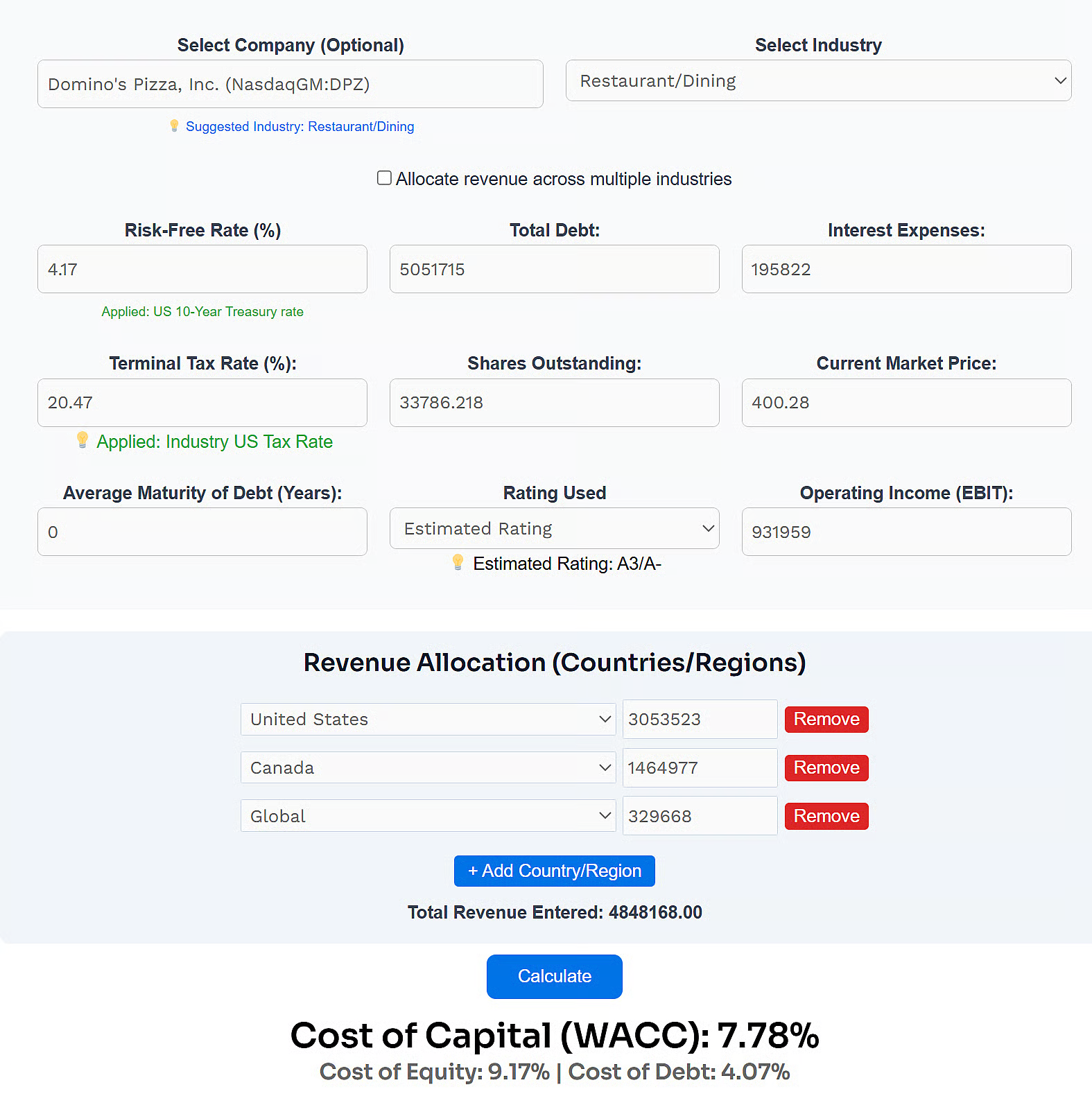
Cost of Capital: 7.78%.
These values will be used later as a discount rate in the valuation methods.
Discounted Cash Flows (Weight: 30%)
I’ve used the latest and annual financial statements of the company, the analyst estimates for both revenue and margins and the cost of capital calculated previously.
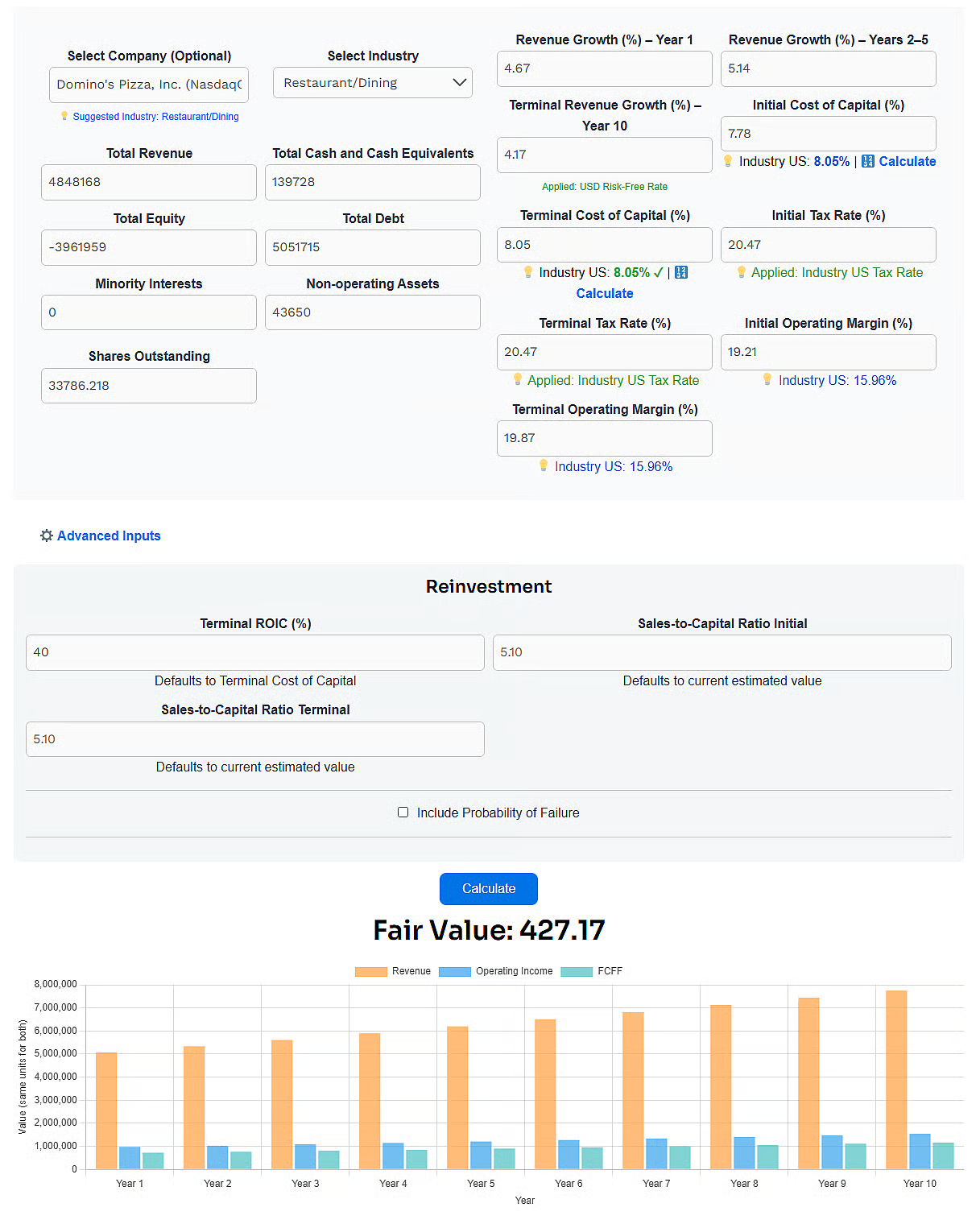
Some notes on the inputs above:
- Terminal Revenue Growth – I’m using the risk-free rate (10-Yr bonds of US), because long term the company should not grow more than the rate of the economy. I’m using the risk-free rate as a proxy to it, so the terminal growth becomes it;
- Terminal Cost of Capital – I’m assuming that the company starts at the previously estimated cost of capital and then will converge gradually to the average cost of capital of its industry;
- Initial and Terminal Tax Rate – Given the maturity of the company and its values very close to the industry (19-20%) I’ve set both values to the industry average;
- Terminal ROIC (Advanced Inputs) – I’ve set this value to 40%, a little below its historical of above 50%. In my opinion it didn’t make sense for this value to become Cost of Capital (~7-8%).
All the other inputs were taken or from the financial statements or from analyst projections.
The DCF gives us an estimated fair value of 427.17 dollars for Domino’s Pizza.
Something that we can also do now is to play around with Monte Carlo simulations. What this will allow us to do is to simulate multiple DCF valuations with pre-defined ranges for each of the inputs. Each simulation will randomize the inputs between these pre-defined values. For this I also used analysts estimates.
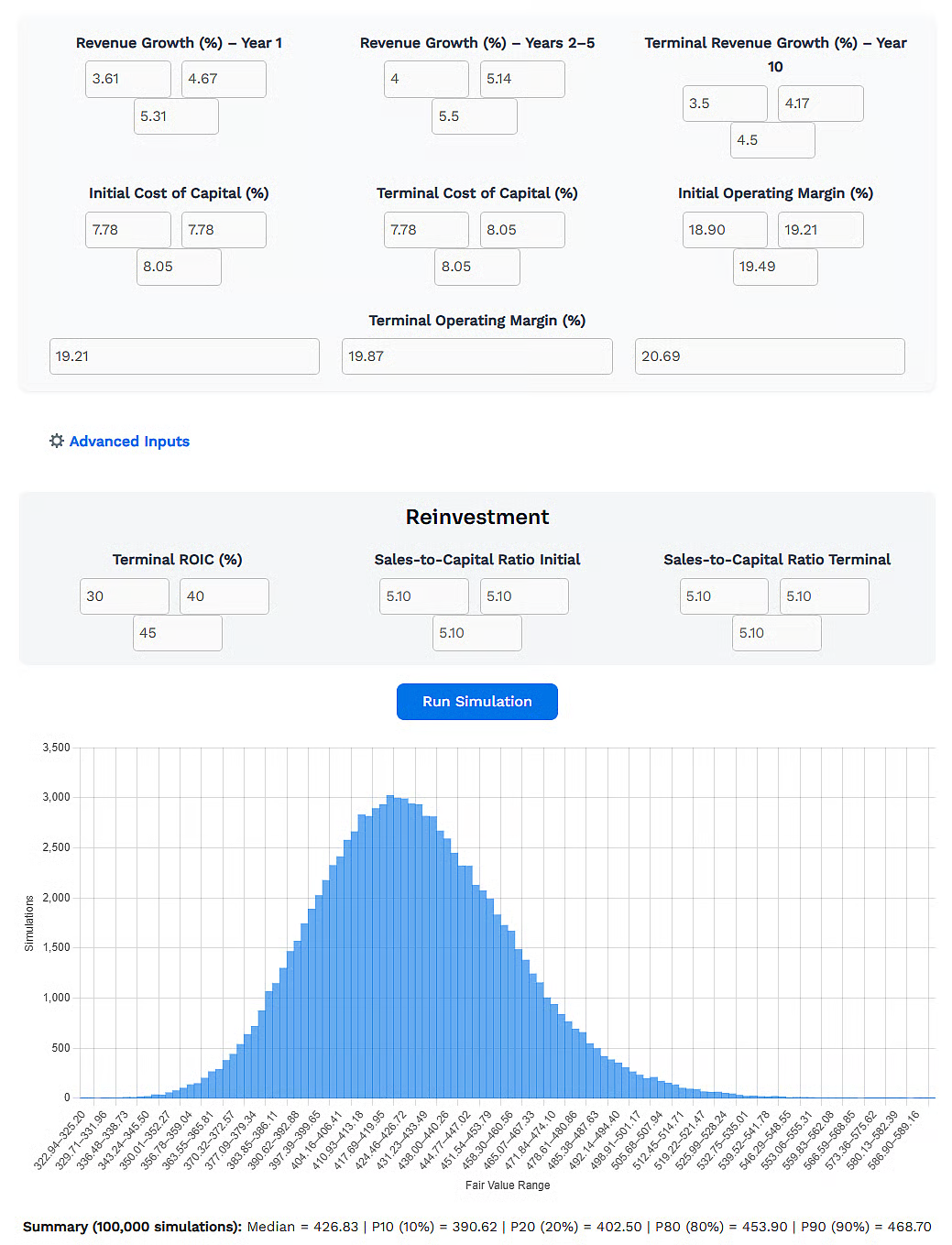
As you can see from the above Domino’s Pizza seems to be a little undervalued or at maximum fairly valued given that its current price of 400.28 dollars is around P20. From these simulations we can extrapolate that there’s 80% probability that the stock is undervalued at the current price.
As always take this single output, from this valuation method, with a grain of salt. Let’s move on to the other valuation methods to get a clearer picture.
DDM – Variable Growth (Weight: 15%)
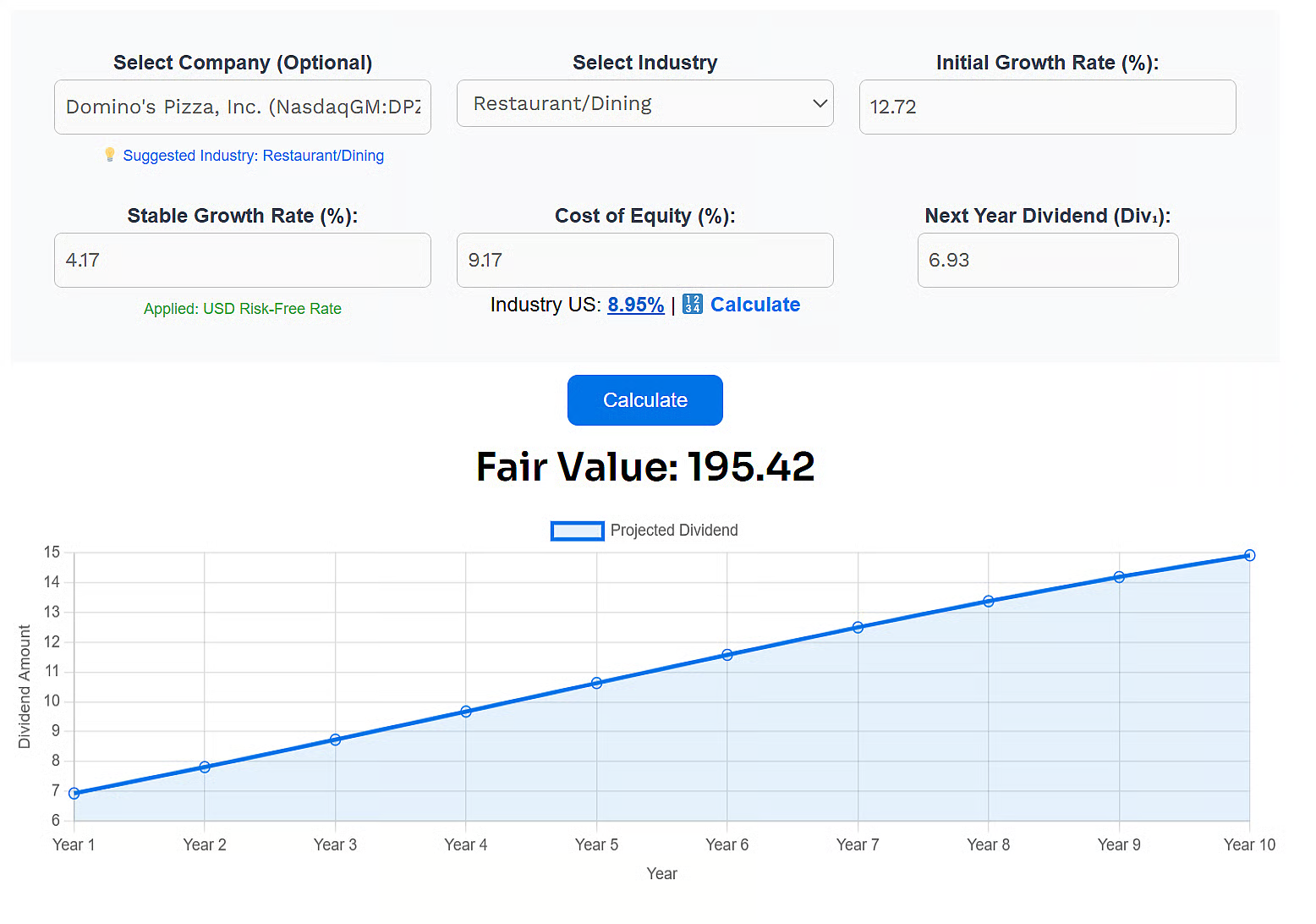
Now we look at a Dividend Discount Model (DDM). This will allow us to value the company, using its dividend payments and the overall growth of it. In this type of DDM we’ll set the dividend to grow at an initial rate that then over time moderates and declines to a given terminal stable growth that will be maintained “forever”.
For the stable growth, I normally use the growth rate of the economy the company is based on, namely the 10-Year bonds of the currency used by that economy country. Given that Domino’s Pizza is an American company, using dollars, we’ll use the 10-Year Bonds of United States.
As you can see below I started the dividend growth at 12.72% (analysts expectations) and then slowly the growth moderates to 4.17% (the risk free rate – 10-Yr bonds of US). Also note the use of the Cost of Equity, calculated previously when we also calculated the Cost of Capital.
Then, as always, we can also use a Monte Carlo simulation to dive deeper into the valuation 🤓
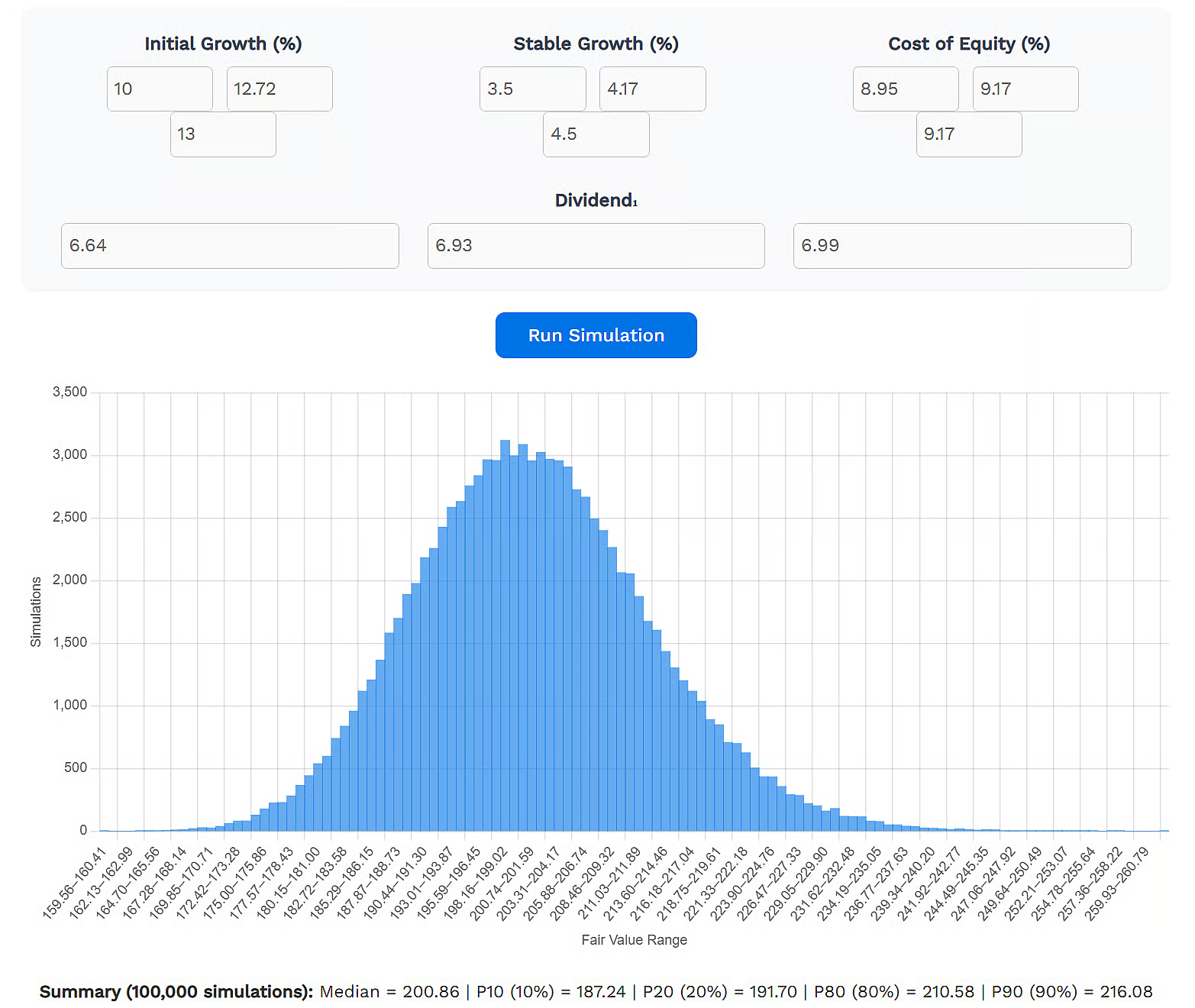
As you can see, by this method, Domino’s Pizza seems overvalued because its current market value is above the upper range of the simulations (P90).
This difference between the DCF and DDM output is closely related to how much the company pays in dividends (Payout Ratio). If most of the Free Cash Flows are to be paid in dividends, the DDM will more closely reflect the real value of the company. Given that currently Domino’s Pizza has a relatively low payout ratio of ~30-40%, the DDM output will undervaluate the company real value.
EPS Growth (Weight: 12%)
For this valuation method, I’ve used the current EPS and the analysts estimates of EPS growth. I also assumed a 20 PE for Domino’s Pizza, so a little below its current averages.
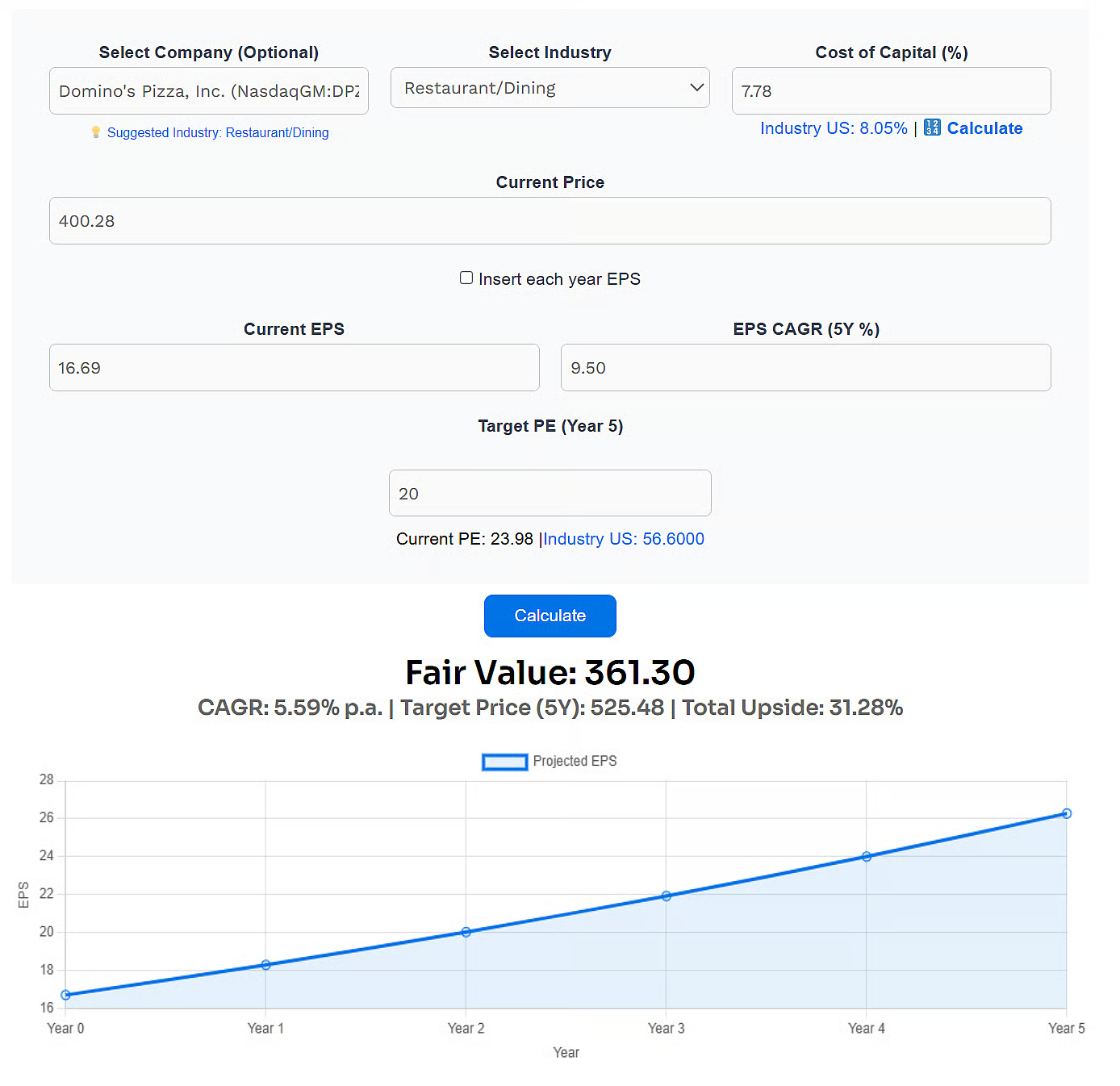
Then again, I used the Monte Carlo simulations to check how the estimated fair value changed as my assumptions were modified.
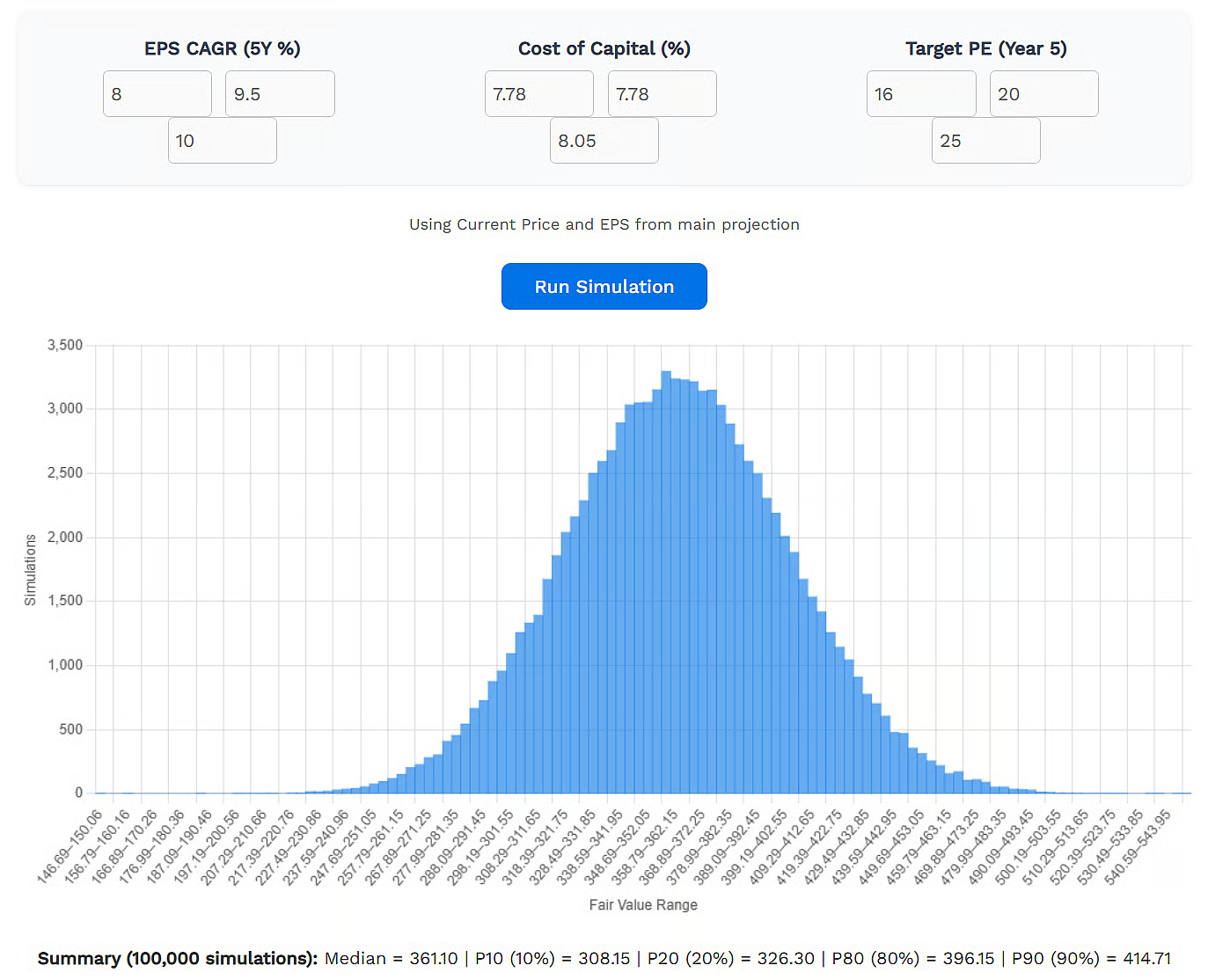
Using this valuation method, Domino’s Pizza that is currently priced at 400.28 dollars seems to be a little overvalued, being currently valued around P80. Given this we can extrapolate that there’s ~80% probability of Domino’s Pizza being overvalued.
This is the inverse of what we’ve seen on the DCF valuation. That’s for this reason that we should not rely only on one valuation method, and use our common sense and the business type to help us choose the most useful valuation methods and their respective weights.
Let’s continue to the historical valuation to elucidate us a little more (I hope).
Historical EV/EBITDA (Weight: 12%)
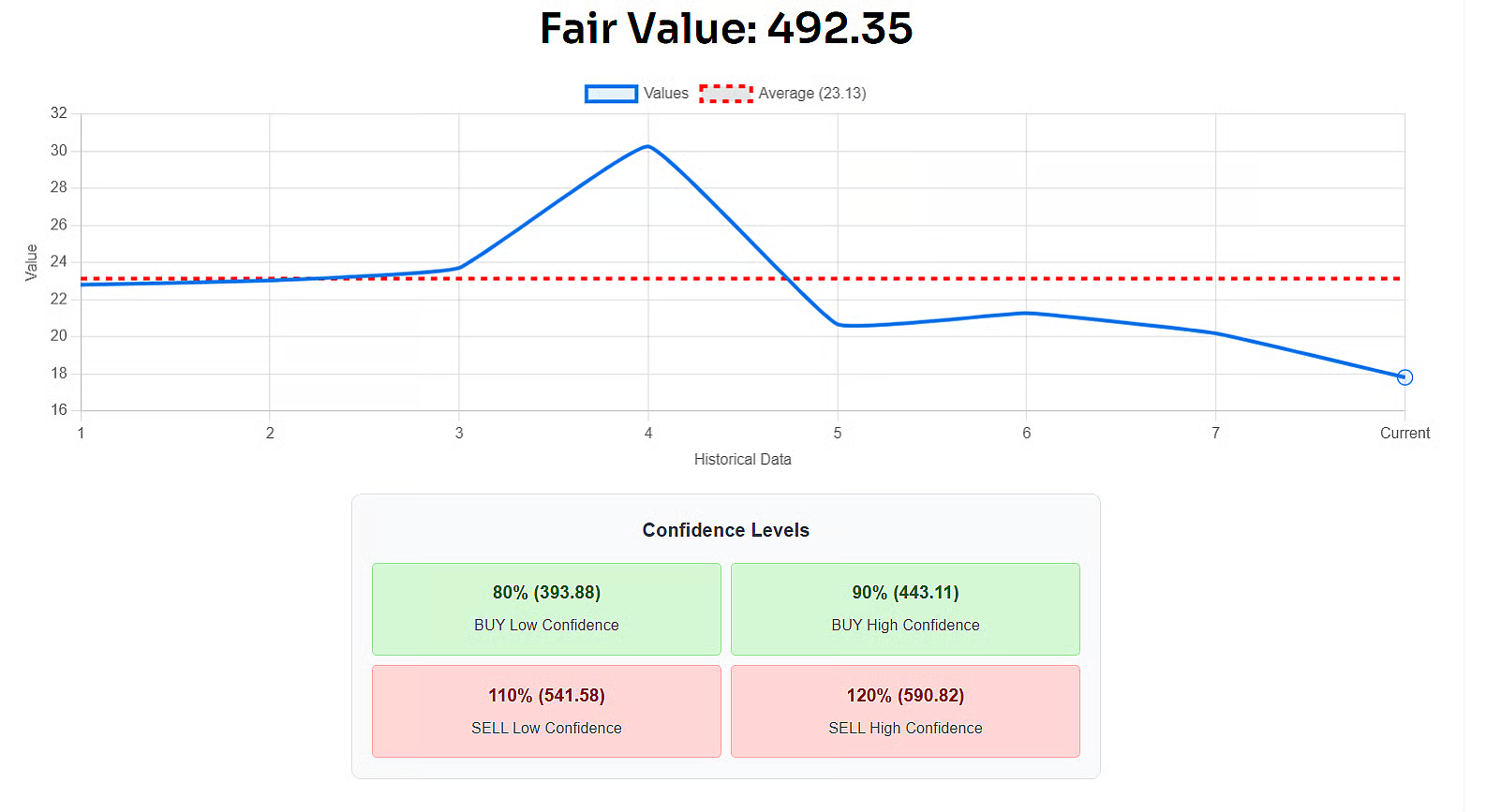
The current EV/EBITDA ratio is below its 7-8 Year average. This means that the company is undervalued by this metric. Assuming a mean reversion to its historical average of 23.13 we can assume a fair value of 492.35 dollars.
Historical P/E (Weight: 10%)

The current P/E ratio is below its 7-8 Year average. This means that the company is undervalued by this metric. Assuming a mean reversion to its historical average of 30.65 we can assume a fair value of 488.38 dollars.
Historical Dividend Yield (Weight: 8%)

The current Dividend Yield ratio is above its 7-8 Year average. This means that the company is undervalued by this metric. Assuming a mean reversion to its historical average of 1.01% we can assume a fair value of 686.68 dollars.
Historical P/CF (Weight: 8%)

The current P/CF ratio is below its 7-8 Year average. This means that the company is undervalued by this metric. Assuming a mean reversion to its historical average of 26.48 we can assume a fair value of 511.37 dollars.
Historical P/S (Weight: 5%)

The current P/S ratio is below its 7-8 Year average. This means that the company is undervalued by this metric. Assuming a mean reversion to its historical average of 3.47 we can assume a fair value of 468.75 dollars.
✍️Summary
Now that we did all the heavy work, let’s take the above and come up with the company weighted average fair value.
I basically take each valuation method used and given my confidence on the company apply a 20% or 10% discount (when to buy) and addition (when to sell) or use the Monte Carlo P10, P20, P80 and P90 values:

Feel free to choose your own values, but for me I will pick a fair value of 393.14 given the maturity, stability and wide moat of the business.
Please remember that the fair value estimate has a 100% probability of being wrong and it will never be a precise number, even if it has decimals next to it 😮
However, overall, Domino’s Pizza seems to be fairly valued or at least a little overvalued at its current valuation.